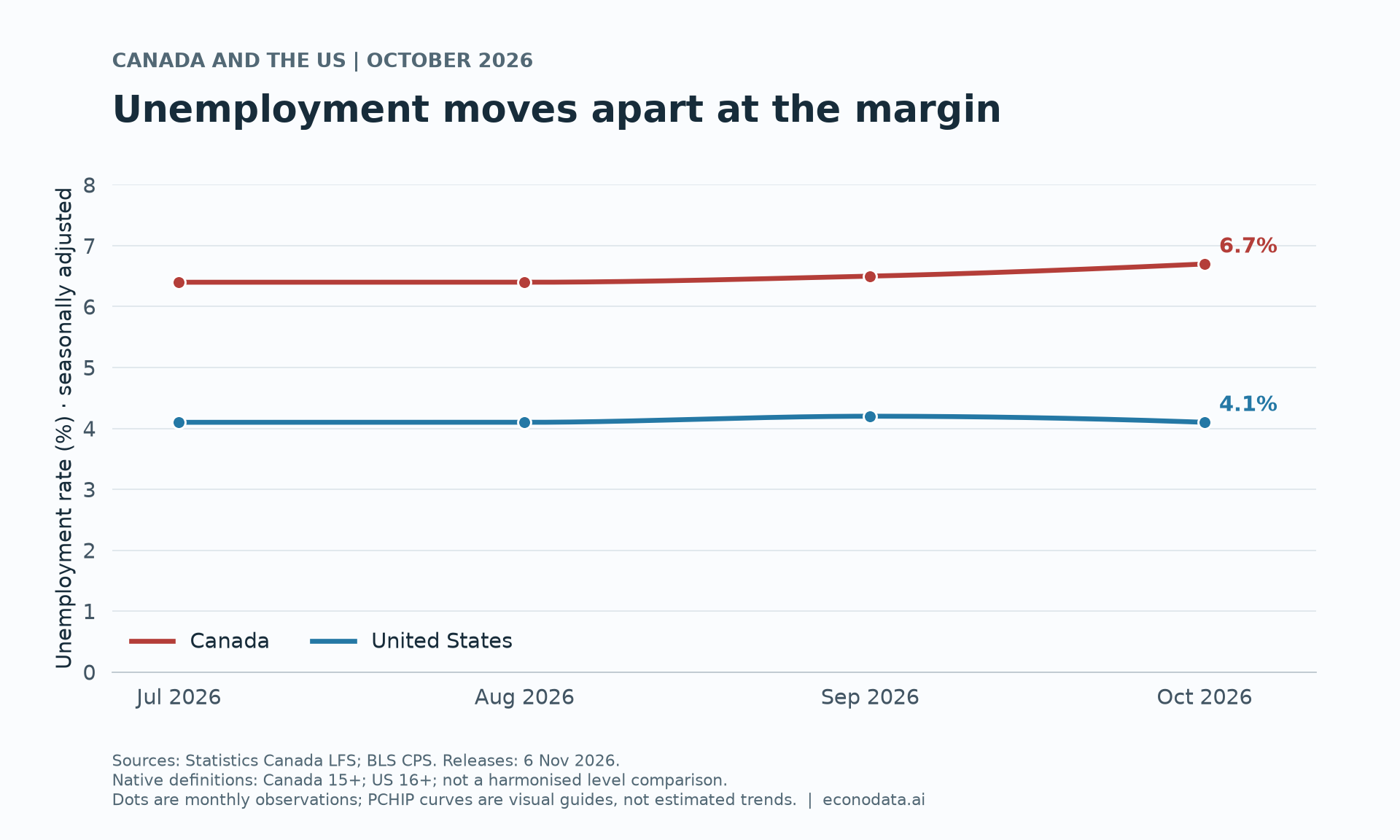
October’s reports point to weaker momentum in Canada than in the US. Canadian employment barely moved after two declines; US payroll growth picked up, with upward revisions behind it.
Canada lost 4,700 employed people, after declines of about 68,000 in September and 42,000 in August. Employment is only 16,500 higher than a year ago (0.1%). Private-sector employees fell 52,500; public-sector rose 49,600—but that public bump was not Ottawa hiring. Public administration rose only about 3,400; educational services (+15,000) and health care (+14,100) did the work, a partial back-to-school rebound after education’s −35,000 drop in September (still −48,000 over the year). Private losses centred on wholesale and retail (−28,800), with soft transportation (−10,100) and accommodation and food (−7,900). Alberta employment fell 24,000, led by services including trade and transport—not a private-sector bright spot. Full-time fell 18,100; part-time rose 13,400. Unemployment rose from 6.5% to 6.7% as the labour force grew while employment edged down.
Finding work remains harder than pre-COVID. In October, 18.9% of September’s unemployed found work, versus 24.6% across the same transitions in 2017–19. The recent October average (2024–25) was 18.2%: some improvement, not an uninterrupted decline. Layoffs were 0.7%, versus 0.6% last year—weak hiring, not a firing wave. (Canadian flows are not seasonally adjusted; chart comparisons are between like months.)
The US added 165,000 payroll jobs (159,000 private). August and September were revised up by 84,000; the three-month average is now 137,000. Unemployment edged from 4.2% to 4.1%. Involuntary part-time work rose 339,000. The latest JOLTS (September) shows hires little changed at 3.4%, quits up to 2.1% from 1.9%, and layoffs and discharges little changed at 1.0%—a bit more willingness to leave jobs, not a pink-slip spike.
Canadian hourly wages rose 2.2% year over year; US private hourly earnings rose 3.1%. Markets read the two reports in opposite directions. In Canada, swaps trimmed December hike odds to about 35% from 40%, and CORRA futures took roughly a third of a hike out of the 2027 path—a shallower hiking cycle, not a pause. In the US, fed funds futures lifted December hike odds to roughly 79% from about 73% just before the release; the terminal barely moved. Pricing moves with every print; neither report settles the next decision. Canadian employment is not the same measure as US payrolls.
Sources: https://www150.statcan.gc.ca/n1/daily-quotidien/261106/dq261106a-eng.htm · https://www.bls.gov/news.release/archives/empsit_11062026.htm · https://www.bls.gov/news.release/jolts.nr0.htm · https://www150.statcan.gc.ca/n1/pub/36-28-0001/2026010/article/00004-eng.htm (LFS and CES 6 Nov 2026; JOLTS September; LFS flow history, Chart 9).