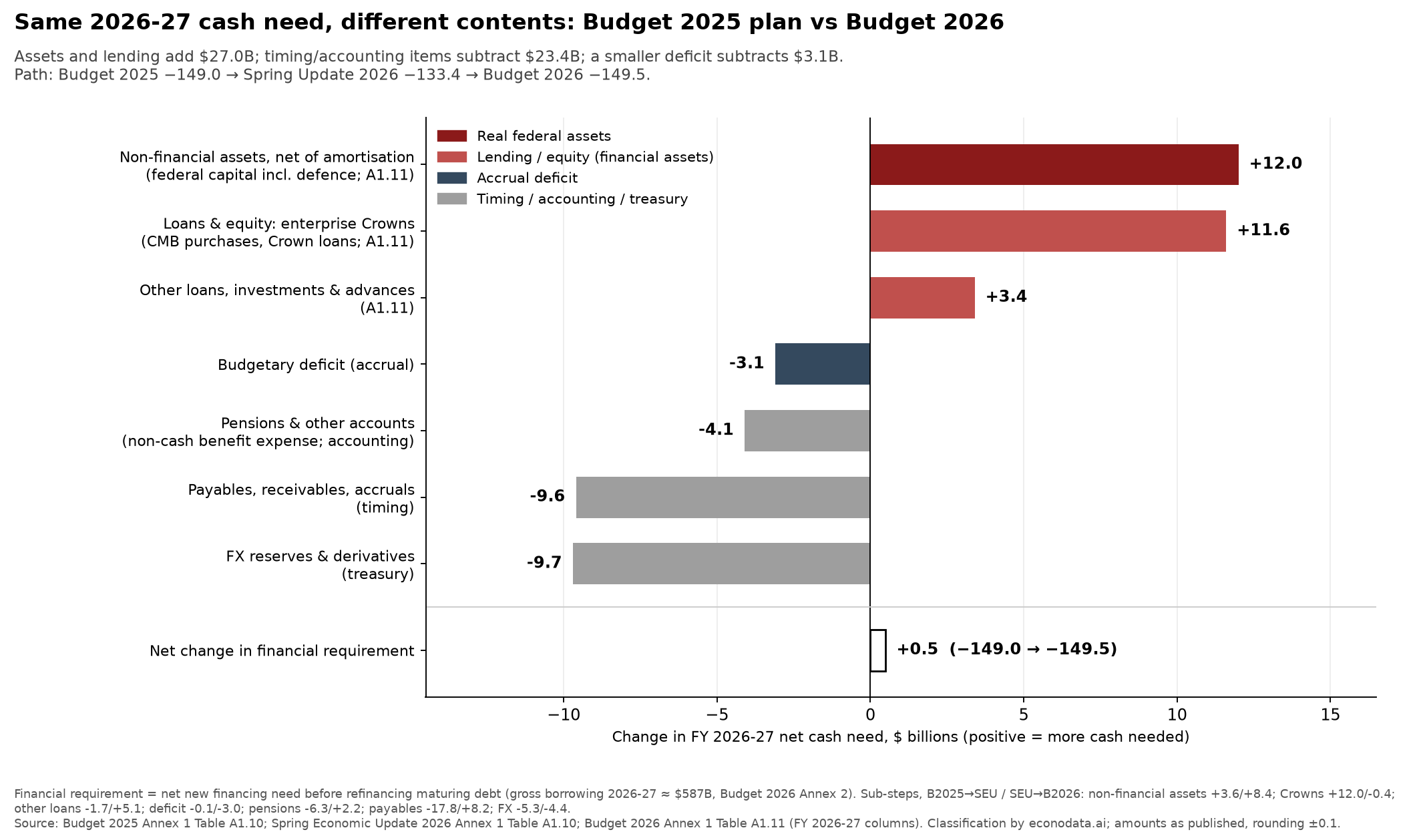
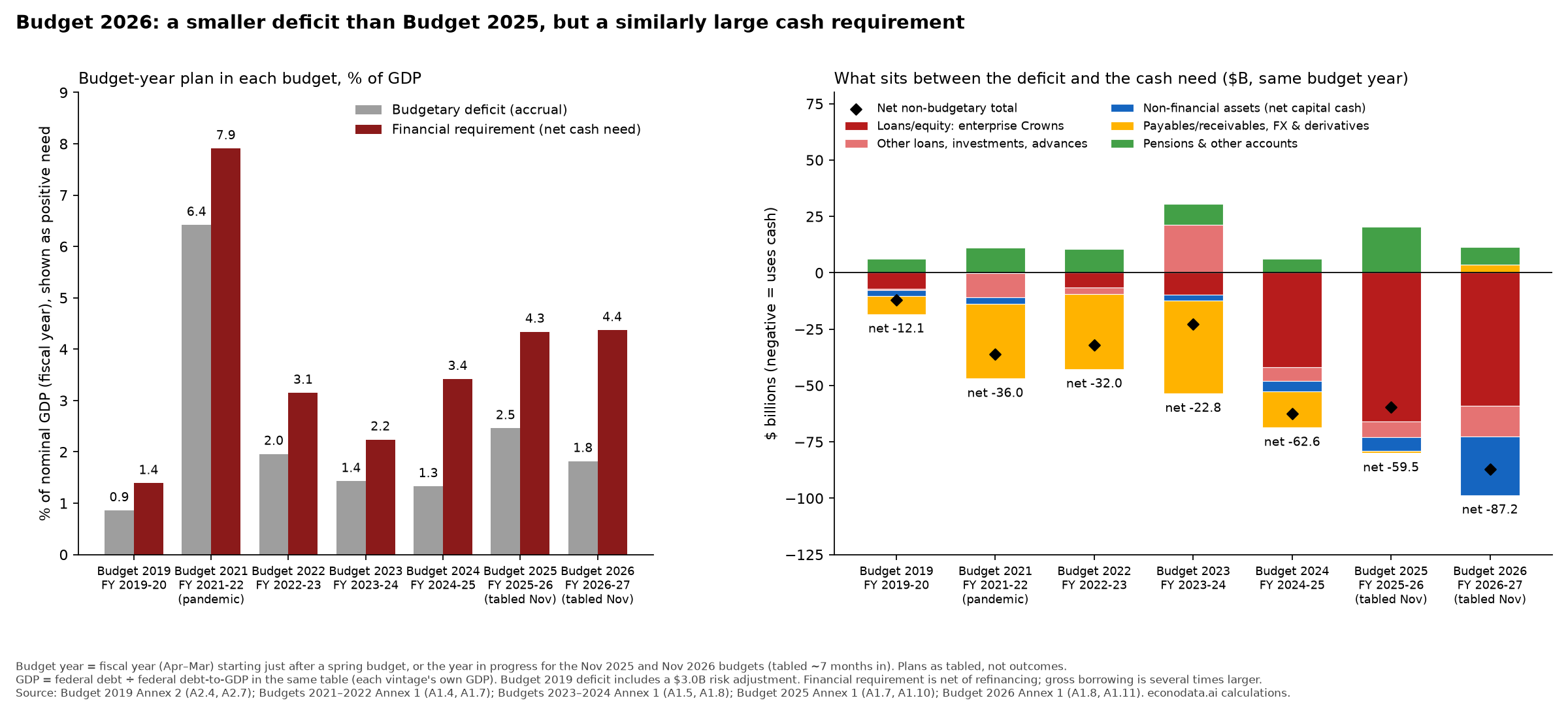
Budget 2026’s financial requirement (FR) for 2026–27 is $149.5 billion, almost the same as Budget 2025’s $149.0 billion plan for that year. The Spring Economic Update (SEU) in April 2026 had cut the same year’s FR to $133.4 billion; Budget 2026 raised it back. The near-match of $149.0 billion and $149.5 billion is a coincidence of two large offsetting revisions, not stability. Figures below are $ billions. The sign convention is minus for a cash need. Fiscal years run April–March. FR is the net new financing need before refinancing maturing debt.
Same fiscal year, three vintages: the 2026–27 financial requirement
| Component (sign: − = cash need) | Budget 2025 (4 Nov 2025) A1.10 | SEU 2026 (Apr 2026) A1.10 | Budget 2026 (5 Nov 2026) A1.11 | Δ B2025→SEU | Δ SEU→B2026 | Δ B2025→B2026 |
|---|---|---|---|---|---|---|
| Budgetary balance (accrual) | −65.4 | −65.3 | −62.3 | +0.1 | +3.0 | +3.1 |
| Pensions and other accounts | +3.8 | +10.1 | +7.9 | +6.3 | −2.2 | +4.1 |
| Non-financial assets | −14.1 | −17.7 | −26.1 | −3.6 | −8.4 | −12.0 |
| Enterprise Crowns (loans, equity, CMBs) | −47.5 | −59.5 | −59.1 | −12.0 | +0.4 | −11.6 |
| Other loans, investments, advances | −10.0 | −8.3 | −13.4 | +1.7 | −5.1 | −3.4 |
| Payables, receivables, accruals, allowances | −10.5 | +7.3 | −0.9 | +17.8 | −8.2 | +9.6 |
| FX activities and derivatives | −5.3 | 0.0 | +4.4 | +5.3 | +4.4 | +9.7 |
| Financial requirement | −149.0 | −133.4 | −149.5 | +15.6 | −16.1 | −0.5 |
Each vintage’s components sum to its FR exactly.
Reading the rotation from Budget 2025 to Budget 2026, for the same year:
- Assets and lending add $27.0 billion of need: non-financial assets $12.0 billion, Crown loans $11.6 billion, other loans $3.4 billion.
- Timing, accounting and treasury items remove $23.4 billion: payables $9.6 billion, FX $9.7 billion, pensions $4.1 billion.
- A smaller deficit removes $3.1 billion.
- Net: $0.5 billion more need.
The timing of the two moves differs. Most of the Crown increase was already in SEU 2026 (−47.5 to −59.5). Neither the Update nor Budget 2026 explains it beyond the standard list (equity in CMHC, EDC, BDC and FCC, Crown Borrowing Program loans, and “up-to $30 billion” Canada Mortgage Bond purchases). Most of the non-financial-asset increase arrives in Budget 2026 (−17.7 to −26.1). Budget 2026 adds a phrase absent from the corresponding text in Budget 2025 and SEU 2026: “including defence purchases of items such as vehicles, ships, aircraft, IT systems, and weapons” (Annex 1, text under Table A1.11). Finance gives no dollar split.
The deficit line itself also nets two large opposite flows for 2026–27:
| Step | Economic and fiscal developments | Policy actions / new measures | Net |
|---|---|---|---|
| Budget 2025 → SEU 2026 (SEU A1.3) | +15.7 | −4.4 actions, −11.3 SEU measures | +0.1 |
| SEU → Budget 2026 (B2026 A1.4) | +21.5 (revenue +19.8, A1.7) | −3.2 actions, −15.2 Budget 2026 measures | +3.0 |
| Total | +37.2 | −34.1 | +3.1 |
So roughly $34 billion of new 2026–27 measures was funded, on paper, by $37 billion of better revenues and forecast changes.
One “forecast change” is itself an assumption about underspending. Budget 2026 says it “reduces projected direct program expenses by about 4.5%, or roughly $12.4 billion per year on average over the forecast horizon, before new measures. This adjustment better aligns the forecast with the expected timing and level of spending” (Annex 1). Finance calls it “an aggregate forecasting adjustment, largely for non-defence, non-capital investments. It is not attributed to particular departments, programs, or policy decisions, and it does not change approved funding” (box “Updating the direct program expense forecast”). It also nets actuarial and discount-rate effects on employee-benefit costs. In 2026–27 that shows up as only +1.5 on direct program expenses (Table A1.7, row 2.3). The bulk lands in 2027–28 onward (+14.4, +13.6, +15.2, +17.3).
Execution so far
The Fiscal Monitor for April–August (unaudited) is the first in-year check:
| 2025–26 Apr–Aug | Share of full year (preliminary) | 2026–27 Apr–Aug | Share of Budget 2026 plan | |
|---|---|---|---|---|
| Non-financial assets | −3.7 | 20% of −18.5 | −5.3 | 20% of −26.1 |
| Loans, investments and advances | −23.7 | 39% of −60.5 | −24.9 | 34% of −72.5 |
| Financial requirement | −47.7 | 46% of −103.9 | −60.1 | 40% of −149.5 |
Non-financial-asset spending is back-loaded every year. At five months, 2026–27 is tracking the same 20% share as last year, on a plan 41% larger. That is neither evidence of slippage nor of delivery yet. September results, the next check, are due by 27 November 2026.
Watchlist
Three Budget 2026 items are most exposed to delay, dilution or reversal. A fourth, the forecasting adjustment, is a risk in the opposite direction.
Defence capital and procurement. Core defence cash rises from $75.1 billion in 2026–27 to $99.2 billion in 2030–31 (Budget 2026 Chart 5.1); the non-financial-asset requirement moves from −26.1 to −39.8. The Parliamentary Budget Officer (6 October 2026) recorded an $18.5 billion cumulative DND capital shortfall from 2017–18 to 2023–24, with reprofiling. Key decisions remain open: the F-35 is “under Government review, including potential alternatives”; submarines are in contract negotiation; airborne early warning is at options analysis. Speaking to the Commons defence committee on 5 October 2026 about the 5% path, the PBO said “to some extent, those plans don’t exist.” Slippage would lower cash need and non-financial assets first; the accrual deficit would move less, because assets are amortised after entering service. The size of any shortfall is not estimable from published data.
Comprehensive Expenditure Review savings. The Treasury Board figures are $9 billion in 2026–27, $10 billion the following year, and $13 billion by 2028–29. The PBO said on 27 January 2026 it was “difficult … to assess the fiscal and operational risks to achieving the stated savings,” and that some organisations’ savings were “not yet … finalized and approved.” In the 7 May 2026 review of the Main Estimates, operating authorities were down 5.1% excluding Canada Post, versus a 7.5% target, and the PBO cautioned that this is not a CER-only measure. Against that, Budget 2026 (Chapter 6, citing Treasury Board) says the public service has “fallen by nearly 10% from its 2023-24 peak of about 368,000 employees, to about 332,000” as of August 2026, and the savings are embedded in the Main Estimates. Missed savings would raise the deficit and the financial requirement one-for-one.
Fuel excise relief. Rates are scheduled to return halfway on 1 February 2027 and in full on 1 April 2027. The relief has already been extended once, on 2 September 2026. Budget 2026 projects other excise revenue rising from $7.7 billion in 2026–27 to $12.9 billion in 2027–28 “as fuel excise tax rates return to their legislated levels” (text under Table A1.9). Another extension would cut into that. The exact cost depends on its length and is not published.
The $12.4 billion a year forecasting adjustment already assumes underspending, so the residual risk runs both ways. If departments do spend authorised amounts, the deficit is higher than planned. The effect is mostly on the accrual accounts (transfers and subsidies are expenses), so both the deficit and the financial requirement would move. The size of any residual miss is not separately published beyond the $12.4 billion a year average.